


From the time I was a teenager, I’ve been mesmerized by history’s great revivals.
From the spiritual eruption of the day of Pentecost to the bold evangelism of Saint Patrick to the sweeping force of the Protestant Reformation to the hundred-year prayer and mission movement of the Moravians, I’ve consumed everything I could get my hands on, trying to wrap my puny mind around what happens when revival strikes.
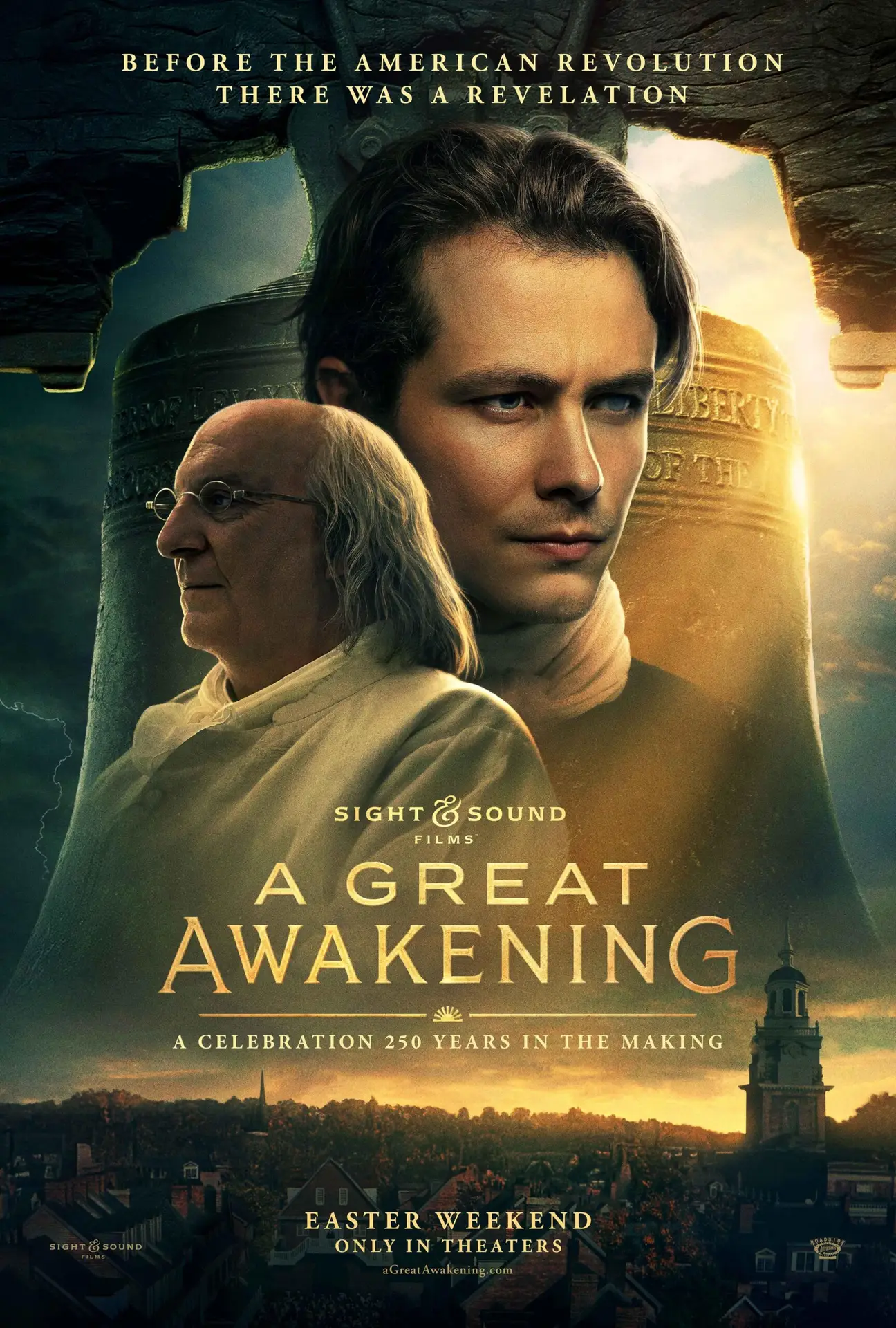
At the center of my studies has been the First Great Awakening, fueled by the preaching of George Whitefield and the leadership and organization of John Wesley. So when I heard that the film A Great Awakening was coming to theaters, I was already all in.
I was in the middle of reading Arnold Dallimore’s massive two-volume biography on Whitefield when the film was announced. That’s 1,200+ pages of revival history, and I still couldn’t wait to see this story on the big screen.
Last Thursday night, my wife and I went with some dear friends. Tomorrow, I’m going again with family. And today? I spent the morning texting and calling friends, telling them, “You need to see this movie while it’s still in theaters!”
The story behind the story
The film tells the story of the First Great Awakening through the lens of Benjamin Franklin.
Now here’s what makes that powerful: Franklin wasn’t a believer—he was a Deist. Yet he deeply loved and respected Whitefield. He was captivated by his preaching and stunned by his ability to move massive crowds.
Through Franklin’s perspective, you get a front-row seat to the impact of one man’s voice on an entire nation. And the numbers are staggering. Did you know that up to 80% of the people living in the American colonies heard Whitefield preach in person at some point in their lives?
Think about that. No microphones. No media. No amplification. Just a man, a message, and the power of God.
Alongside leaders like Jonathan Edwards and John Wesley, God used Whitefield to spark a spiritual awakening, especially among young people, that transformed the colonies. It transformed them spiritually and prepared them politcally.
Whitefield died just three years before the signing of the Declaration of Independence. But his preaching helped prime the 13 colonies to become a republic.
Through the power of simple, Gospel-Advancing, free-grace preaching, people were transformed—spiritually, mentally, and emotionally—into a nation ready to be “of the people, by the people, and for the people.” That’s why many have called George Whitefield America’s Spiritual Founding Father.
Here are five reasons I loved this movie so much:
1. It brings the First Great Awakening to life.
The film does an outstanding job of showing Whitefield’s early journey, from aspiring actor to Oxford student to member of the university’s Holy Club, alongside John and Charles Wesley.
It doesn’t sanitize Whitefield’s story either. It shows his early attempts to earn salvation through extreme discipline—fasting, sleepless nights, relentless effort. He nearly died trying to reach God through works, until he encountered the gift of grace through faith alone in Christ alone, based on His finished work on the cross alone.
And when he did, everything changed.
2. It captures Whitefield’s radical strategy.
After his conversion, Whitefield didn’t preach like anyone else in England. He preached with urgency, passion, and total surrender. When churches shut their doors, he took the message outside to fields, hillsides, and coal mines. He even carried a portable stage on horseback.
And people came by the thousands, sometimes the tens of thousands, to hear him preach. Even Charles Spurgeon—known as the Prince of Preachers—called Whitefield the Chief of Preachers. That tells you everything you need to know.
3. The acting is next level.
The performances are strong across the board, but Jonathan Blair’s portrayal of Whitefield is outstanding. And much of the dialogue is drawn directly from Whitefield’s actual sermons, so you both watch history and hear it.
Franklin once estimated Whitefield could be heard by up to 30,000 people, from a mile away. Watching those scenes of him preaching, I felt like jumping up in the theater and preaching myself.
4. It reveals the spiritual founding of America.
The film opens and closes with the Continental Congress and the formation of the Constitution, highlighting the tension and complexity of building a nation.
But it makes something clear: The U.S.’s political formation didn’t happen in a vacuum. It was preceded by spiritual transformation. Whitefield’s influence reached far beyond church gatherings, and it shaped the very soul of a nation.
5. It’s simply a good movie.
I love movies, but only good ones. This is a good one: well-acted, well-paced, well-told.
What it means for today
Because it’s based on real history, this film is a reminder of what can happen. Because the same God who moved during the First Great Awakening hasn’t changed.
But we must ask these questions:
- Are we desperate enough to seek Him again?
- Are we bold enough to preach the Gospel again?
- Are we willing to believe in awakening again?
Go see this movie. Bring your friends. Let it stir your heart. But don’t let it stop at inspiration. Let it lead to action, to proclamation, to desperation before God. Because history changes when people are awakened.
It’s time for another Great Awakening.
May it start with the next generation, and spread from sea to shining sea.